The ViaNase™
Difference
Researchers and scientists have spent the last 25 years trying and failing to develop effective treatments for many unmet needs including brain diseases. The majority of the traditional treatments methods available can’t bypass the blood brain barrier, leaving the majority of the medication behind in the nasal cavity, sinuses, or GI tract. Other methods also can produce a number of undesirable side effects.







Why the brain is so hard to reach
Getting medicine into the brain is one of the hardest problems in medicine. Most treatments taken by pill, injection or standard nasal spray never reach it in meaningful amounts.
The blood-brain barrier
The brain’s blood vessels are lined with tightly packed cells that keep most substances in the bloodstream from reaching brain tissue.
Air flows the wrong way
About 90% of the air you breathe in travels straight back along the floor of the nose toward the lungs. Medicine has to travel up, against that flow, to reach the nerve pathways to the brain.
Sprays and nebulizers miss the target
Most medicine from a standard nasal spray is swallowed and ends up in the stomach. Nebulizers send most of theirs to the lungs.
Higher doses, more side effects
So little of a pill or IV infusion reaches the brain that treatments often need large doses, which circulate through the whole body. For some drugs, such as insulin, dosing this way isn’t safe.
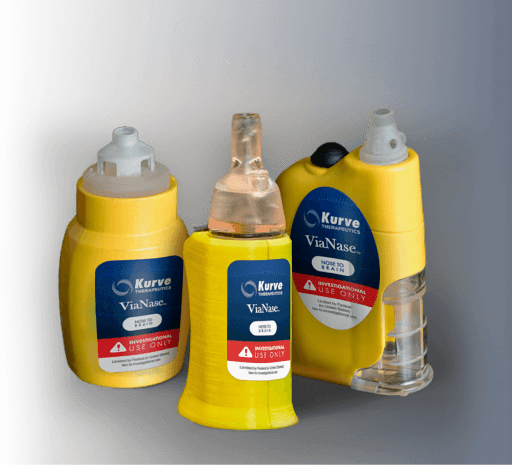
ViaNase™ is designed to overcome these obstacles. Kurve’s patented Controlled Particle Dispersion® technology directs medication to the top of the nasal cavity, where nerve pathways lead directly to the brain, so less of the dose ends up elsewhere in the body.
Designed for everyday use
Brain-to-plasma ratio
Intranasal vs. systemic dosing
How much drug reached brain tissue compared with blood. Above 1.0 means more in the brain than in the bloodstream.
Reduction in systemic side effects
Reduction of systemic side-effects by ensuring less medication reaches non-targeted areas.
01
Enhances the opportunity for bioavailability
Enhanced opportunity for bioavailability by delivering medication where it needs to go in the nasal cavity and brain.
02
Non-invasive / painless
Non-invasive / painless intranasal drug delivery.
03
Odorless / tasteless
Odorless / tasteless intranasal drug delivery.
04
User-friendly
Our device is easy to use: get the correct dose every time with the click of one button!
05
Increased patient compliance
Non-invasive, simplified, and features user-friendly modes of administration, all of which encourage patient compliance and use while minimizing application errors.
06
Lightweight / pocket-sized
Conveniently fits in your pocket!
07
Battery-powered
Easily recharge your device from home.
08
Fast and easy to administer
It only takes a few seconds to administer with the click of one button!
Thoroughly Vetted
Kurve Therapeutics’ revolutionary treatment system is featured in 18 peer-reviewed publications by leading institutions such as: